
Physics Fridays - Paper No. 15

Updated: Apr 28
Why AI Is Being Mistaken for a Cost-Cutting Tool
Author: Robert Dvorak
Founder, BlueHour Technology
“Equations are merciless.”
— Richard Feynman
When the structure of a system is wrong, the outcomes eventually reveal it.
Artificial intelligence has crossed a threshold.
Capability is proven.
Deployment is accelerating.
Investment is massive.
The question now being asked—by Boards, investors, and executive teams—is direct:
Where is the return?
The First Visible Answer
In many organizations, the first answer is appearing quickly:
Headcount reduction.
Costs decline.
Margins improve.
AI is credited.
It is immediate.
It is measurable.
It satisfies expectations.
And it is being misread as success.
The Tell
In the absence of system-level redesign, enterprises default to the most visible lever:
Cost reduction.
This is not strategy.
It is a tell—
that the operating model cannot convert intelligence into value.
The Misdiagnosis
AI is not a cost-cutting tool.
It is being used that way because it is being deployed into operating models that were never designed to absorb it.
Most enterprises are still structured around:
deterministic workflows
static roles
fragmented decision systems
legacy IT architectures
Introducing probabilistic intelligence into that environment does not produce transformation.
It produces friction.
Complexity rises.
Coordination weakens.
Value becomes harder to extract.
Labor becomes the easiest variable to adjust.
The Critical Error
Framing AI as a substitute for Human Intelligence is not just incomplete.
It is catastrophically wrong.
Human Intelligence is not a cost center.
It is the system’s capacity for:
judgment under uncertainty
contextual interpretation
ethical boundary setting
cross-domain synthesis
trust formation
When Human Intelligence is reduced, the system does not simply become more efficient.
It becomes less intelligent.
The Physics of the System
The equation is not optional:
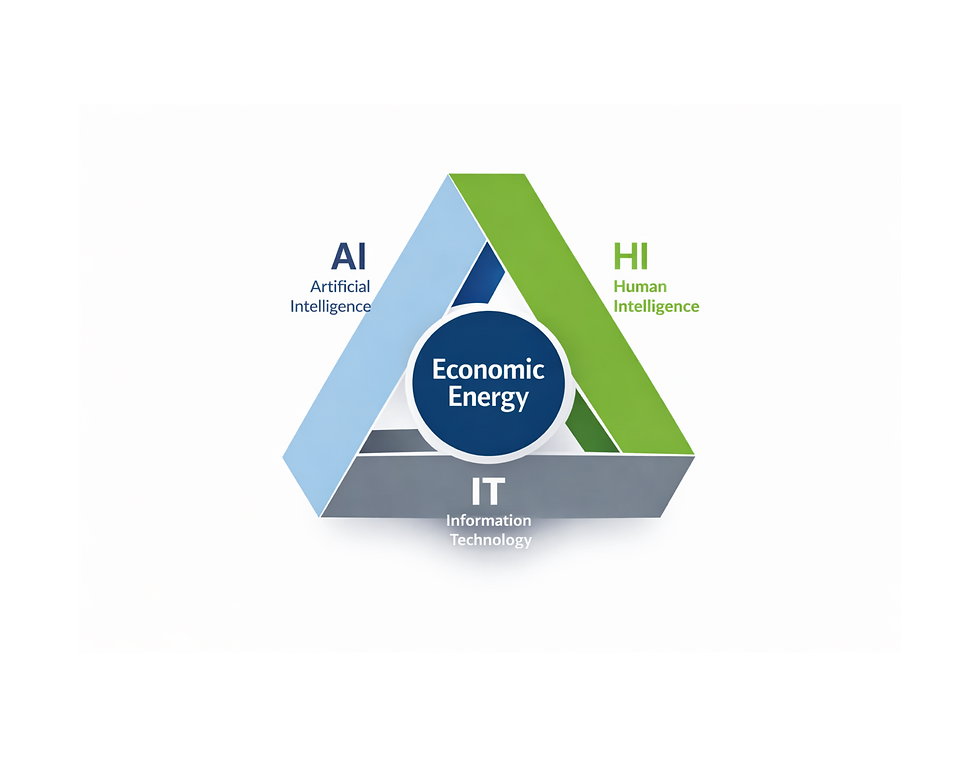
AI × IT × Human Intelligence × Operating Architecture = Economic Energy
Each variable is multiplicative.
Reduce one, and the system underperforms.
Ignore one, and the system misfires.
Align all, and the system compounds.
If AI increases while Human Intelligence is reduced, total system output does not expand.
It contracts.
If Operating Architecture remains unchanged, energy dissipates before it converts into value.
The result is predictable:
Local efficiency.
Global underperformance.
Why This Is Happening
Organizations are under pressure to demonstrate return on unprecedented levels of investment.
In that pressure, they reach for what is immediate:
visible cost savings
clean financial narratives
fast signals to the market
Headcount reduction delivers all three.
But it does not resolve the underlying system constraint.
Two Paths From Here
Path 1: Cost Extraction
Deploy AI into existing workflows
Reduce headcount
Report efficiency gains
This produces:
short-term financial improvement
reduced Human Intelligence capacity
constrained long-term performance
The system becomes leaner.
And less capable.
Path 2: System Design
Redesign the operating architecture
Integrate AI, IT, and Human Intelligence as a unified system
Enable continuous workforce mobility and capability evolution
This produces:
expanded capacity
faster and better decisions
revenue growth
operating leverage
The system becomes more intelligent.
And more valuable.
Accountability Concentrates
AI does not absorb accountability.
It concentrates it.
Leadership is accountable for:
the design of the operating system
the integration of intelligence
the evolution of the workforce
the outcomes produced at scale
There is no deferral to the machine.
There is only the system—and those who designed it.
The Leadership Standard
This moment is not about adopting AI.
It is about designing for it.
CEOs are accountable for enterprise value, not cost optics
CIOs are accountable for system architecture, not tool integration
CHROs are accountable for Human Intelligence evolution, not workforce reduction
Operating models are no longer passive structures.
They are active determinants of performance.
The Reality
AI does not determine outcomes.
Operating Architecture does.
The equation will resolve.
It always does.
The only question is direction:
Contraction, through cost reduction and shrinking intelligence
or
Expansion, through engineered systems that amplify it
Closing
Work is being reconfigured across AI, IT, and Human Intelligence.
Upboarding employees for perpetual relevance strengthens the system and expands its total intelligence capacity.
The AI × IT × Human Intelligence system is not a substitution model.
It is a design model.
And design determines outcome.
Comments